High school can feel painfully slow when you already know what's next.
Maybe you're academically ahead, burned out, eager to start college, ready to work, or itching to travel. Sitting through another year of classes that don't move the needle can feel like wasted time.
So, How to Graduate High School Early?
Here's the truth: graduating high school early is possible—and thousands of students do it every year. But it's not accidental. It requires planning, discipline, and a clear understanding of how the system actually works.
This guide is built for ambitious students who want a real, step-by-step path—not vague motivation or unrealistic promises.

The Quick Answer: How to Graduate High School Early
If you want the short version, there are five proven ways students graduate early:
- Dual enrollment (earning college and high school credit at the same time)
- Summer school & winter intersessions
- Testing out of classes (CLEP or state proficiency exams)
- Online accredited high school courses
- Overloading your schedule (zero period, 7th period, or extra classes)
Most early graduates use a combination of these strategies.
Can You Actually Graduate Early? (The Feasibility Check)
Before you plan anything, you need to answer one question honestly:
Is early graduation mathematically and legally possible for you?
Understanding the "Credit Math"
High schools operate on a credit system—usually based on Carnegie Units.
- A full-year class = 1 credit
- A semester class = 0.5 credit
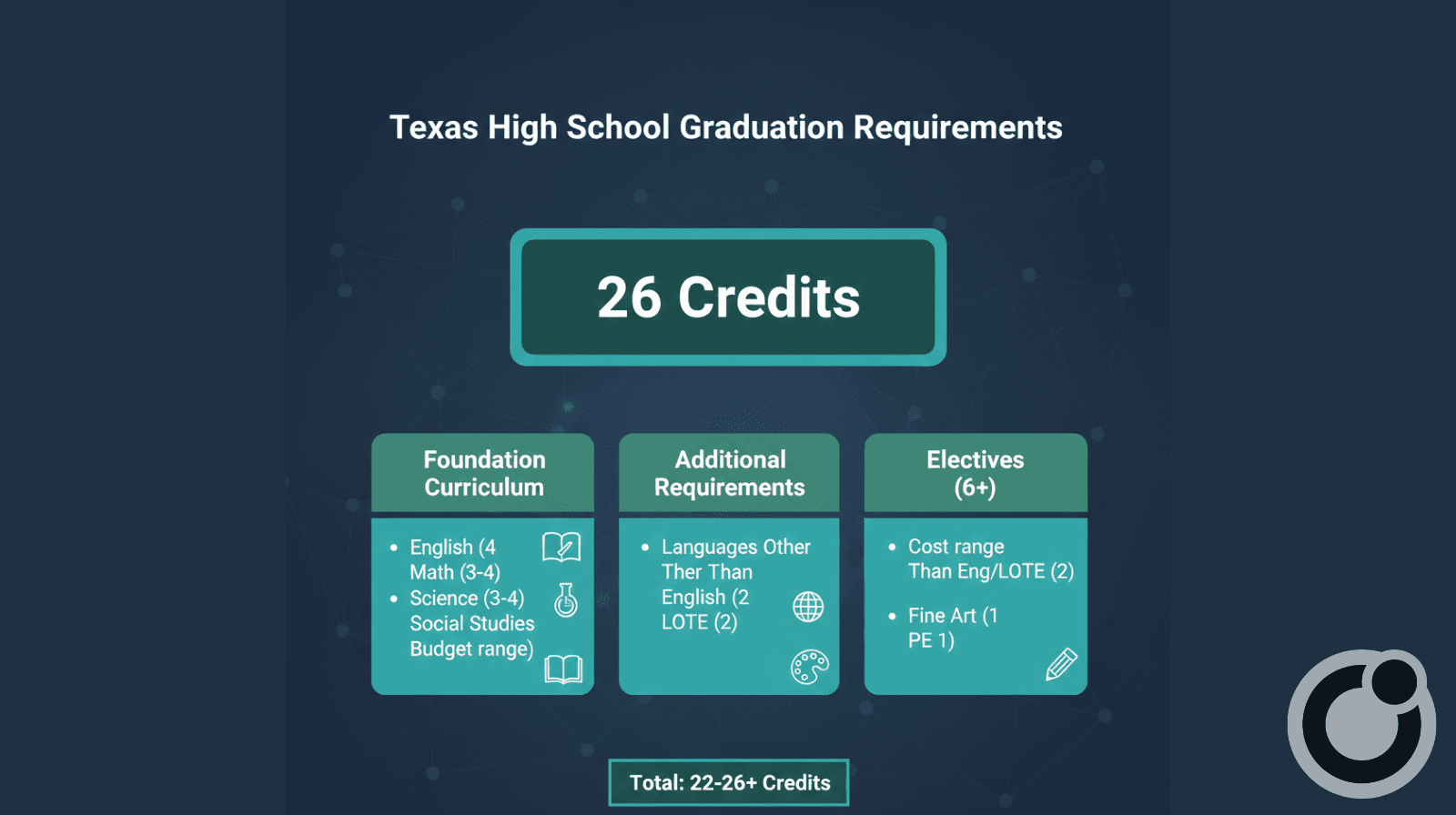
- Most states require 20–26 total credits to graduate
These credits are split into:
- Required subjects (English, Math, Science, Social Studies)
- Electives
- Sometimes PE or Health
How to Calculate Your Credit Deficit
- Look at your transcript
- Write down:
- Credits earned so far
- Credits required to graduate
- Subtract what you have from what you need
- Factor in how many semesters remain
That gap is your credit deficit—and every strategy in this guide exists to close it faster.
State and District Requirements (The Hidden Constraint)
Here's what many students miss:
Some states and districts require seat time, not just credits.
That means:
- You might need to be enrolled for a minimum number of semesters
- Certain courses (like Civics, PE, or Health) may be mandatory in-person
- Some districts restrict how many credits can be earned online or externally
5 Proven Strategies to Fast-Track Your Diploma
This is the core of early graduation. These strategies work—and when stacked together, they're powerful.

1. Maximize Summer School & Winter Intersessions
Summer school is no longer just for credit recovery.
High-achieving students use it to:
- Knock out English or History
- Complete graduation requirements early
- Free up time during the school year
Best use cases:
- Non-lab classes
- Requirements you don't need sequentially
- Classes that don't affect GPA heavily
2. Dual Enrollment (The "College Hack")
Dual enrollment is one of the most efficient ways to graduate early.
You take classes at:
- A community college
- A partner university
- Sometimes online
And they count as:
- High school credit
- College credit
One class fills two buckets.
Examples:
- College English → High School English credit
- College Government → Civics requirement
This strategy is especially powerful for juniors aiming to graduate one year early.
3. "Testing Out" (Credit by Exam)
If you already know the material, you may not need the class.
Many states allow students to earn credit through:
- CLEP exams
- State proficiency tests
- District-level challenge exams
You study → take the test → earn the credit.
This is ideal for:
- Math
- History
- Foreign languages
- Subjects you've self-studied or accelerated in
Availability varies by state, so approval is required.
4. Online High School Courses
Accredited online programs allow you to take extra classes:
- At night
- On weekends
- During free periods
Popular options include:
- State virtual schools
- University-affiliated programs
- District-approved platforms
These courses are best for:
- Electives
- Health or PE credits
- Filling schedule gaps
Consistency matters more than intelligence here—online courses punish procrastination.
5. Overloading Your Schedule (Zero & 7th Periods)
This is the grind method.
You take:
- A zero period (before school)
- A 7th period (after school)
- Or both
It's exhausting—but effective.
This approach works best when combined with:
- Summer classes
- Dual enrollment
Be realistic. Burnout is the #1 reason early graduation plans fail.
The Execution Timeline: How to Plan It
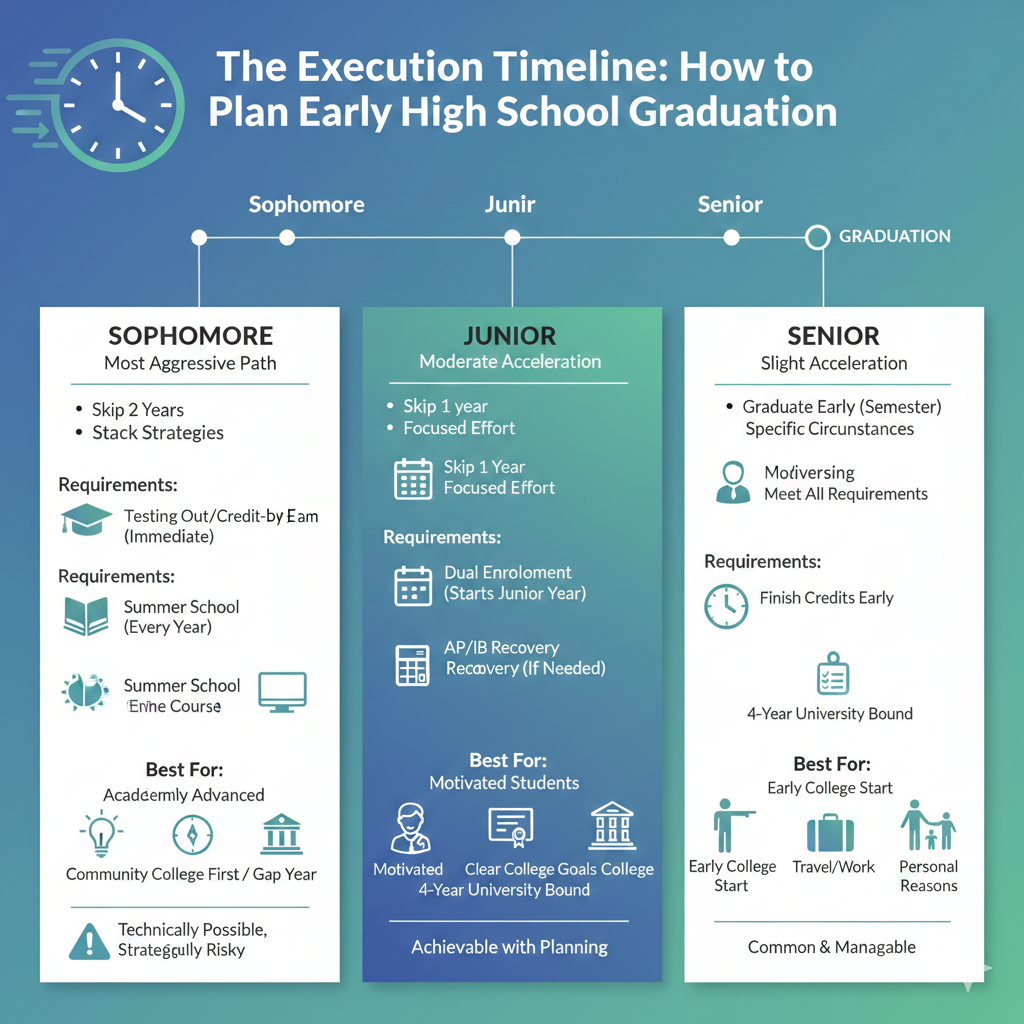
Once you understand the strategies, success comes down to timing. Graduating early looks very different depending on whether you are a sophomore, junior, or senior.
How to Graduate High School Early as a Sophomore
This is the most aggressive path and requires near-perfect execution.
Sophomores aiming to graduate early are usually trying to skip two full years of high school. This is only feasible if you are willing to stack multiple acceleration strategies at once.
Typical requirements:
- Heavy use of testing out or credit-by-exam
- Dual enrollment starting immediately
- Summer school every year
- Online courses running in parallel with in-person classes
This path works best for students who are:
- Academically advanced
- Highly self-directed
- Planning to attend community college first or take a gap year
For most students, this route is technically possible but strategically risky.
How to Graduate High School Early as a Junior (One Year Early)
This is the most common and realistic early graduation path.
The goal is to complete all senior-year requirements by the end of junior year.
Typical strategy:
- Dual enrollment for English and Government/Economics
- Summer school after sophomore year
- Online or overloaded electives
- Completing remaining requirements during junior year
This path is ideal for students who want:
- Traditional college admissions
- Scholarship eligibility
- A strong academic narrative
If you are serious about graduating early, this is the path most guidance counselors are comfortable approving.
The Senior "Half-Year" Graduation Option
Some students finish high school in December instead of May.
This option allows you to:
- Start college in the spring
- Take a gap semester
- Work or travel early
It usually involves:
- Finishing English and core requirements early
- Completing electives during summer
- Maintaining enrollment until graduation eligibility is met
This is a powerful compromise for students who want flexibility without the intensity of full early graduation.
The "Nuclear Option": GED vs. Early Graduation
This distinction is often misunderstood, and many articles fail to explain it properly.
What Is the Difference?
Early graduation means:
- You earn a standard high school diploma
- You meet all state and district graduation requirements
- Colleges see you as a traditional graduate
A GED is:
- A certificate of equivalency
- Not a diploma
- Treated differently by colleges, employers, and scholarship committees
They are not interchangeable.
When Should You Consider a GED?
A GED can make sense if:
- You are already accepted to a community college
- You are pursuing a specialized career path
- Your school blocks early graduation options
- Traditional schooling no longer fits your situation
However, for students targeting competitive colleges or scholarships, early graduation with a diploma is almost always the better choice.
Is Graduating Early Worth It? (Pros and Cons)
Graduating early is not inherently good or bad. It is a tradeoff.
The Strategic Advantages
- You save money by entering the workforce or college sooner
- You demonstrate discipline, planning, and independence
- You gain flexibility for gap years or alternative paths
- You avoid senior-year academic stagnation
For motivated students, this can strengthen a college application narrative when explained correctly.
The Hidden Costs
- Social tradeoffs like missing prom or senior traditions
- Higher risk of academic burnout
- Younger age may affect dorm placement or social integration
- Less time to build leadership roles or extracurricular depth
These costs are real and should not be dismissed.
Essential Checklist Before You Commit
Graduating early should never be a solo decision.
Talk to Your Guidance Counselor (Script Included)
Schedule a meeting and ask directly:
- What are the total credit requirements for my district?
- Are there mandatory in-person or seat-time courses?
- How many external or online credits are allowed?
- Will early graduation affect my diploma status?
Do not proceed without written confirmation of approval.
Check Your Target College's Policy
Before locking in your plan:
- Confirm colleges accept early graduates
- Ask how age affects housing and scholarships
- Understand whether spring or fall enrollment is better
Most colleges accept early graduates, but assumptions can be expensive.
Frequently Asked Questions (FAQs)
Final Thoughts
Graduating high school early is a sprint, not a marathon.
It rewards students who plan carefully, communicate clearly, and execute consistently. For the right student, it can unlock time, opportunity, and momentum. For the wrong one, it can cause burnout and regret.
Do not decide based on emotion alone.
Download your transcript, do the credit math, talk to your counselor, and build a plan that fits your goals—not someone else's timeline.
.jpg&w=3840&q=75)


.jpg&w=3840&q=75)