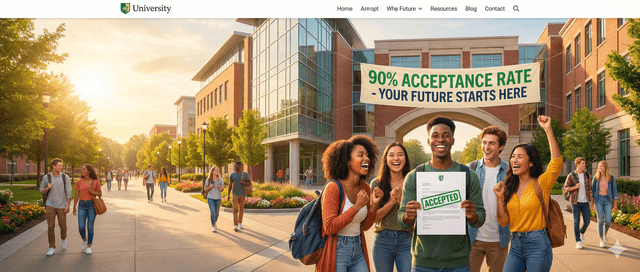
Beyond the "Backup": Reclaiming the Safety School for 2026
"A safety school is only a safety if it’s a school you would be thrilled to attend on a full scholarship."
Every year, thousands of students with 4.0 GPAs and 1550 SATs find themselves in "April Limbo"—rejected from their reaches, waitlisted at their targets, and staring at a safety school they never bothered to visit. In 2026, the best safety schools are no longer just "easy gets." They are strategic powerhouses that offer high-achievers a different kind of prestige: the prestige of being a "Big Fish in a Small Pond."
As the landscape of US higher education shifts toward "yield protection" and "test-optional" confusion, identifying safety schools in the USA requires more than a glance at a ranking. It requires an analytical audit of acceptance rates, merit aid grids, and honors college perks. If you are a high-performing student, your safety school should not be a compromise; it should be a platform for accelerated success.
Defining the "True Safety" in 2026
A school is not a safety just because your counselor said so. It must meet four data-driven criteria simultaneously to qualify as one of the top safety schools on your list:
- Acceptance Rate Benchmark: For high achievers, a safety should generally have an acceptance rate above 50%. Any school under 30% is a "Target" or "Reach," regardless of your stats.
- The 75th Percentile Rule: Your GPA and test scores must be at or above the school’s 75th percentile. If you are in the 50th percentile, it’s a Target.
- Major-Specific Nuance: You might be a "Safety" for the College of Liberal Arts but a "Reach" for Computer Science or Engineering.
- Financial Predictability: A safety is only a safety if your family can afford the Net Price without needing a miracle.
The Academic Positioning Matrix
Use the table below to determine if your profile puts you in the "Safety Zone" for a mid-tier public or private university. This data represents a composite of good safety colleges across the Midwest and South.
| Metric | 25th Percentile | 50th Percentile | 75th Percentile (Safety Zone) |
|---|---|---|---|
| Unweighted GPA | 3.4 - 3.6 | 3.7 - 3.8 | 3.9 - 4.0 |
| SAT Score | 1150 - 1250 | 1300 - 1400 | 1450 - 1550+ |
| ACT Score | 24 - 27 | 28 - 31 | 33 - 36 |
Categorizing the Best Safety Schools
Not all safety schools in the USA are created equal. Depending on your goals, you should pick from these five strategic tiers:
1. The "Public Flagship" Tier
Large, research-heavy institutions with massive alumni networks. Because they are mandated to serve their state, many maintain higher acceptance rates while offering Tier-1 research status. These are often the top safety schools for students looking for a "traditional" college experience.
Key Strategy: Look for schools with R1 status from the Carnegie Classification of Institutions of Higher Education to ensure high research funding.
2. The "Public Honors" Tier (The High-Achiever's Paradise)
This is the "Safety" for the student who wants an Ivy League experience at a public price. You get the small class sizes and priority registration of a boutique college with the sports and spirit of a major state school.
3. Strong Regional Public Universities
Often overlooked, these schools dominate their local job markets. If you want to work in a specific city, a regional safety there might have better local recruiting than a national reach elsewhere.
4. Private Universities (60–80% Acceptance)
These schools often use "Tuition Discounting" to attract top-tier students, making them competitive with public school pricing for high-GPA applicants.
5. The "Automatic Merit" Tier
Schools that use transparent, grid-based scholarship systems. If you have X GPA and Y SAT, they give you Z dollars. No "holistic" guessing involved. This provides ultimate financial safety.
Curated List: 15 Best Safety Schools in the USA (2026)
This list focuses on schools where high-achieving students are highly likely to be admitted AND will find elite-level academic opportunities. We have included direct links to their official admissions pages for your audit.
Arizona State University (ASU)
Acceptance Rate: ~89-90% | Barrett Honors College
Why it's strong: Ranked #1 for Innovation. Barrett students have dedicated honors housing and a $12M endowment for research and travel.
Best for: Engineering, Business, and Sustainability.
University of Alabama
Acceptance Rate: ~76-80%
Why it's strong: Unbeatable automatic merit aid. They are a top producer of National Merit Scholars due to their generous funding packages.
Best for: Law, Business, and Engineering.
Michigan State University (MSU)
Acceptance Rate: ~85-88%
Why it's strong: Global brand with top-10 programs in Supply Chain Management and Packaging. Huge R1 research footprint.
Best for: Business, Agriculture, and Veterinary Science.
University of Oregon
Acceptance Rate: ~86-93% | Clark Honors College
Why it's strong: Clark Honors College offers a 15:1 class size and a senior thesis requirement that rivals small liberal arts colleges.
Best for: Journalism, Environmental Studies, and Architecture.
Iowa State University (ISU)
Acceptance Rate: ~89-91%
Why it's strong: A STEM powerhouse in the Midwest. Known for its massive Career Fairs and high placement in the aerospace and agricultural sectors.
Best for: Aerospace Engineering, Agriculture, and Design.
University of Texas at Dallas (UTD)
Acceptance Rate: ~85-87%
Why it's strong: Located in a major tech hub (Silicon Prairie). Famous for generous National Merit and Presidential scholarships.
Best for: Computer Science, Data Science, and Management.
University of Kansas (KU)
Acceptance Rate: ~91-92%
Why it's strong: A member of the elite Association of American Universities (AAU). Excellent outcomes for pre-professional tracks.
Best for: Pharmacy, Education, and Engineering.
Miami University (Ohio)
Acceptance Rate: ~88-89%
Why it's strong: Often ranked #1 for undergraduate teaching. It offers a liberal arts feel with the resources of a public university.
Best for: Business (Farmer School), Marketing, and Education.
Colorado State University (CSU)
Acceptance Rate: ~90%
Why it's strong: Leader in veterinary medicine and environmental research. High quality of life in Fort Collins.
Best for: Veterinary Science, Forestry, and Biomedical Sciences.
Butler University
Acceptance Rate: ~81-82%
Why it's strong: Ranked #1 Regional University in the Midwest. 98% placement rate within 6 months of graduation.
Best for: Pharmacy, Dance, and Business.
University of Mississippi (Ole Miss)
Acceptance Rate: ~90-97%
Why it's strong: Home to the nationally recognized Barksdale Honors College. Excellent "Full-Ride" potential for high-stats students.
Best for: Accounting, Pharmacy, and Liberal Arts.
University of Kentucky
Acceptance Rate: ~91-94%
Why it's strong: Lewis Honors College offers a high-touch experience. Significant automatic merit scholarships for out-of-state students.
Best for: Health Sciences, Equine Science, and Business.
University of Texas at Arlington (UTA)
Acceptance Rate: ~80-93%
Why it's strong: A Carnegie R1 university that is highly accessible. Located in the DFW metroplex with massive internship pipelines.
Best for: Nursing, Engineering, and Social Work.
University of Wyoming
Acceptance Rate: ~97%
Why it's strong: One of the lowest tuition rates in the country. The "Cowboy Commitment" offers clear, grid-based merit aid.
Best for: Geology, Petroleum Engineering, and Agriculture.
Temple University
Acceptance Rate: ~80%
Why it's strong: Urban campus in Philadelphia with elite programs in Business (Fox) and Media/Communications.
Best for: Business, Health Professions, and Fine Arts.
Strategic Comparison of Top Safety Schools
Use this table to quickly compare the structural advantages of our top picks for the 2026 cycle. High-achieving students should prioritize schools with a "Yes" in the Honors column.
| School Name | Acceptance Rate | Key Strength | Merit Aid? | Honors? |
|---|---|---|---|---|
| Arizona State (ASU) | ~90% | Innovation/Tech | Yes (Grid) | Yes (Barrett) |
| Univ. of Alabama | ~78% | National Merit | Automatic | Yes |
| Michigan State | ~88% | Supply Chain | Holistic | Yes |
| Univ. of Iowa | ~84% | Writing/Health | Yes (Automatic) | Yes |
| UT Dallas | ~87% | Computer Science | Automatic | Yes (Hoblit) |
Major-Specific Safety Mistakes: The Engineering Danger Zone
One of the most common errors in building a list of top safety schools is ignoring "departmental selectivity."
For example, Purdue University or Virginia Tech may have respectable overall acceptance rates, but their **Computer Science and Engineering acceptance rates** are often 1/4th of the university average. If you are applying for a competitive major, you MUST find a school that is a safety for that specific program. A school like Iowa State or Arizona State is a much better "Major-Specific Safety" because they maintain more accessible standards for their Tier-1 engineering colleges.
Before you call a school a safety, verify if the "College of Engineering" has a separate, more selective admission process. If it does, your 75th percentile stats might only place you in the 25th percentile for that major.
Why Emotional Satisfaction Matters in Safeties
A safety is only a safety if it's a school you'd actually attend. Too many students build "Rejection-Only" lists—lists where the only schools they get into are ones they haven't researched and don't like. This leads to a miserable freshman year and a high likelihood of transferring. The best safety schools are ones where you can see yourself joining a specific club, living in a specific dorm, and being proud of the degree on your resume.
To ensure your list aligns with your actual personality, use the AI College Counselor to run a "Culture Fit" check on your safety schools.
"The most successful students aren't those who got into the highest-ranked school; they are those who found the best environment to become the highest-ranked version of themselves."
Strategic Checklist: How to Build a Bulletproof Safety School List
Use this 5-step checklist to ensure you never face a "rejection-only" April. Your best safety schools list should be as carefully curated as your reach list.
- The 2-School Rule: Ensure you have at least two schools on your list with a 60%+ acceptance rate where your SAT/GPA scores sit comfortably in the top 25%.
- The "Major" Audit: Double-check that your intended major (like CS, Nursing, or Engineering) doesn't have a restricted, significantly lower acceptance rate than the general university.
- The Honors Check: For every safety, investigate their Honors College. This is the premier way to secure private-school perks and smaller class sizes at public-school prices.
- The Net Price Run: Always use the institution's Net Price Calculator. If the "Expected Family Contribution" exceeds your budget, it is academically a safety but financially a reach.
- The Emotional Vibe: Take a virtual campus tour. If this becomes your only choice on May 1st, would you be proud to attend? If the answer is "No," it doesn't belong on your list.
Frequently Asked Questions about safety schools
Don't leave your safety to chance.
The difference between a stressful April and a successful one is a well-built list. Start organizing your safeties, targets, and reaches today with our Application Planner.




.png&w=3840&q=75)
.png&w=3840&q=75)
.png&w=3840&q=75)